Find the perfect property for your dream home.
View
Social Responsibility
Gypsum Recycling at Clayton® Facilities Combines Innovation, Sustainability
July 22, 2025
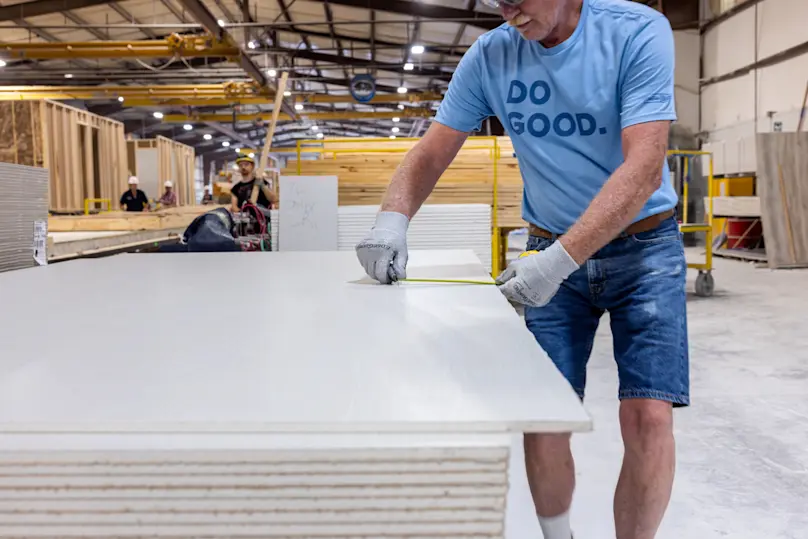
At Clayton, our sustainability efforts are part of our company’s purpose: to develop housing innovations that improve lives and help build a better tomorrow. These efforts involve working with and supporting our local communities.
Initiatives to reduce waste from construction at our home building facilities help us become more efficient with the resources and raw materials we use to build our homes. The construction industry is one of the largest generators of waste worldwide, and Clayton believes we can change that when it comes to single-family housing.
Last year, Clayton home building and supply facilities diverted 123 million pounds of waste from landfills through recycling efforts. Home construction can be more efficient, and we know that innovation is key to helping us achieve our vision to deliver attainability and sustainability in the homes we build. This is especially true when that innovation is led by our team members. The Clayton Giles home building facility has exemplified this, establishing a gypsum recycling partnership that has been replicated at other Clayton home building facilities in east Tennessee.

The Problem
It began with a problem: The landfill in New Tazewell, TN, is full, several years ahead of when it was anticipated to be. A new landfill site has not yet been approved, and it’s not certain where exactly the new site will be located. This need inspired team members at Clayton Giles to figure out how they could find additional outlets for leftover materials.
According to Lisa Lujan, Environmental Health and Safety Manager at the facility, team members love being good stewards of their small community, and understand that everything the home building facility can responsibly keep out of the landfill also keeps it out of their own backyards.
“We have changed how we think,” Lisa said. “Reduce, reuse, recycle is great, but it starts with rethink.”
While looking for solutions, the facility found an area where they could make an impact: scrap sheetrock. Sheetrock, also known as drywall, is a construction material used for interior walls and ceilings, and is a leading contributor to construction waste across the industry. Despite being recyclable, there are limited outlets for scrap sheetrock, so the majority is often sent to landfills.
However, sheetrock is primarily made of the mineral gypsum, making it ideal for composting. It provides key nutrients to the soil and also helps improve its structure for better water drainage.

The Experience
In 2021, Clayton Savannah, where Lisa previously worked, was awarded the Governor’s Environmental Stewardship Award in Materials Management for their efforts to recycle sheetrock with a nearby state park.
Clayton Savannah had examined the facility’s waste streams and found that wood and sheetrock were among the most common waste materials, but often proved difficult to recycle. They joined the Tennessee Green Star Partnership, which is an environmental leadership program facilitated by Tennessee’s Department of Environment and Conservation. With the department’s support, they worked to create the right sheetrock composting mixture. And the relationships the team built were also beneficial to demonstrating how this recycling concept could work.
In 2021, Lisa came to Clayton Giles to help create a similar process.

The Partnerships
In February 2022, Clayton Giles began partnering with Rockwood Sustainable Solutions, a recycling company in Lebanon, TN, as they began trials to recycle drywall that could then be added to soil.
In late 2023, as Rockwood’s business grew, they announced the opening of the state’s first drywall recycling facility. That December, Clayton Giles conducted a pilot project with Rockwood’s partner Arrowhead Ag, an agricultural products company also located in Lebanon. Rockwood accepts the sheetrock scraps and then sorts, sizes and processes them, including removing the board’s laminated paper, before they are sent to Arrowhead Ag for further processing and distribution. The final ground gypsum product then has several potential uses, including as a soil additive or fertilizer.
Lisa noted it was important to work with passionate companies that can deliver a good product and are also looking to be a force for good in their communities, just as Clayton is.

The Community
To help ensure the success of the program and buy-in from their team, Clayton Giles wanted to make sure it would be easy for team members to sort and stage the scrap material. One of the big questions was how to collect the excess sheetrock, and then how to transport it to Lebanon. The scrap material would need to be loaded and transported via truck, similar to how the facility receive raw materials.
Both Lisa and Bill Shipley, the facility’s Environmental Health and Safety Coordinator, agreed on the importance of sharing the story behind why they were asking team members to focus on this recycling effort. Clayton Giles has been a part of the community for 65 years. Residents love to be outside on the lake or hunting and fishing, so there’s a genuine desire to preserve those natural resources, Lisa said.
And it’s that love of community that led team members to design their own jig to maximize the amount of sheetrock that could be sent for recycling and help with weight distribution. The team created a three-sided box with a pallet bottom that would make it easier to stack and band the material for shipment before it’s loaded onto the truck. Currently, each shipment weights about 40,000 pounds.
“This didn’t happen overnight, but has evolved,” Bill said of the process.

The Future
With the costs to send waste materials to the landfill on the rise, Giles is now actually paying less to recycle the sheetrock. And because they typically still have some space in the truck once it’s been loaded, they’re also working to see what other materials they can recycle, like plastic wire spools.
Since the beginning of the project, over 3.1 million pounds of gypsum board have been recycled from Clayton Giles alone. And that’s just the beginning. Several other Clayton facilities in East Tennessee are now recycling their gypsum through the Rockwood partnership, including TRU® White Pine, Clayton Bean Station, Clayton Appalachia and Clayton Maynardville. In total, Clayton facilities have recycled 6.2 million pounds of gypsum so far.
“We have a responsibility to be good stewards and neighbors in the communities where we live and work, said William Jenkins, Clayton Home Building Group® Vice President of Sustainability. “Often, our greatest opportunities stem from our greatest impacts. This partnership is a great example of a team leading change in their community, helping to build responsible outlets for their scrap materials, in turn reducing their local waste impact and supporting other businesses. We’re proud of their ingenuity.”
Learn more about Clayton's social responsibility efforts at claytonhomes.com/social-responsibility
© 1998-2026 Clayton.